
From Gamma to Delta: Exploring the Secrets of Brainwave States

“The human brain has 100 billion neurons, each neuron connected to 10,000 other neurons. Sitting on your shoulders is the most complicated object in the known universe.”
- Michio Kaku, Theoretical Physicist
Have you ever wondered about the fascinating world inside your brain and how it functions at different levels of consciousness?
The brain plays an integral role in shaping our experience of the world, yet we often overlook the impact it has on our reality.
I became interested in how the brain develops and in brainwave states after being introduced to the work of experts like Dr. Joe Dispenza and Dr. Bruce Lipton. It became clear to me that understanding how the brain operates is crucial for effectively harnessing the power of the unconscious mind to create positive changes in our lives.
In this blog post, we will explore the five primary brainwave states and how the brain develops as we age. Understanding these states can provide valuable insights into optimizing mental performance, improving states of relaxation, enhanced creativity, and accessing the untapped potential of the unconscious mind.
Introduction to brainwave states:
Small electrical currents are produced by the brain as billions of neurons connect and communicate with one another. The electrical pulses generated by interconnected networks of brain circuits are known as “brainwaves”. These can be categorized into distinct brainwave states which each have their own unique characteristics and effects on our mental and physical well-being.
There are 5 distinct brainwave states that are observed listed from the fastest level of activity to the slowest.
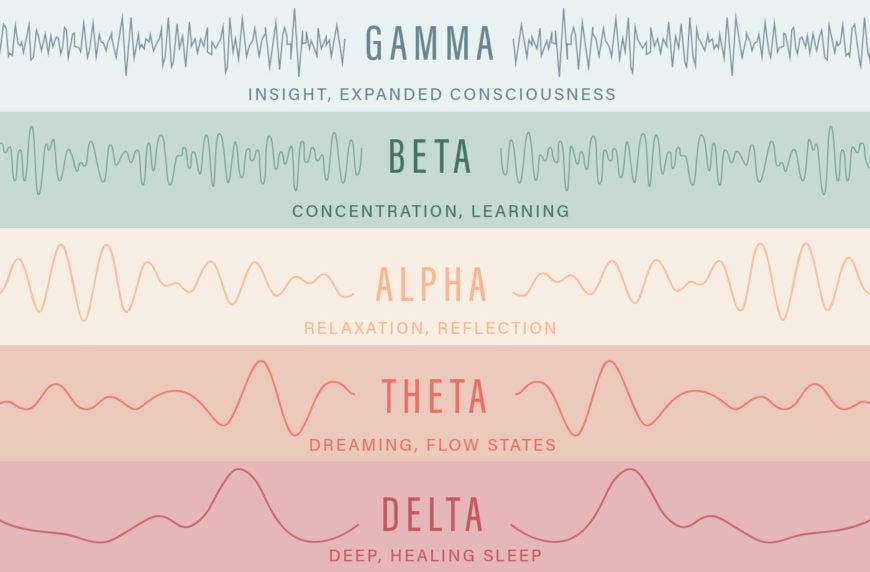
Image credit: towardsdatascience.com
Gamma (32 - 100+ Hz):
At the pinnacle of brainwave frequencies, Gamma waves are associated with heightened perception and peak mental states. When your brain enters the Gamma state, you experience increased focus, heightened sensory perception, and enhanced cognitive processing. Gamma brainwaves have been observed to last longer and appear more regularly in Buddhist Monks and other long-term meditators.
Characteristics associated with Gamma brainwaves include:
Increased learning abilities
Problem-solving tasks
Heightened perception
Peak focus
Expanded consciousness
Beta (13 - 32 Hz):
The Beta state occurs when your brain is aroused, actively engaged in mental activities, and focused on the external world. This state is associated with active conversation, decision making, problem-solving, and intense focus.
Due to our fast-paced modern lifestyles, adults often spend a significant amount of time in the Beta frequency range. While Beta waves contribute to productivity, concentration, and alertness, excessive Beta activity can lead to difficulties in focusing, inhibited creativity, and increased stress levels.
It is important engage in a variety of mental activities to balance Beta waves and harness their benefits while avoiding burnout. Excessive Beta activity triggers the release of stress hormones, which can result in feelings of anxiety and being overwhelmed if sustained for prolonged periods of time.
Characteristics associated with Beta brainwaves include:
Active conversation
Debate / Negotiation
Decision making
Problem solving
Task oriented focus
Learning new skills and concepts
Alpha (8 - 13 Hz):
As the frequency of our brainwaves decreases, our focus shifts from the external world (Beta) to our internal world (Alpha).
The Alpha state signifies relaxation and mental clarity. It is commonly experienced during activities like meditation, leisurely walks, and engaging in creative endeavors. In the Alpha state, both hemispheres of the brain synchronize, facilitating access to previously learned information, reduced anxiety, and heightened emotional states.
Regularly accessing the Alpha state offers a number of benefits, including improved mental clarity, stress reduction, and an increased ability to reprogram limiting beliefs.
Characteristics associated with Alpha brainwaves include:
Going for leisurely walk
Practicing yoga
Meditation
Engaging in creative and artistic pursuits
Deep relaxation before falling asleep
Theta (4 - 8 Hz):
Theta waves are associated with deep relaxation, increased creativity and, trance-like states. When you enter the Theta state, you experience a sense of inner peace, improved memory, and heightened intuition. This state is often connected to dreaming, daydreaming, engaging in creative processes, and hypnosis.
When the brain shifts into Theta, conscious mental activity diminishes, allowing for greater access to the unconscious mind— the part of the mind where beliefs and programmed behaviors are stored.(More on this later…)
Some of the benefits of intentionally accessing Theta waves includes reduction of mental fatigue, heightened intuition, improved memory, and enhanced imagination.
Characteristics associated with Theta brainwaves include:
Deep meditation
Daydreaming
Dreaming while sleeping
Flow state
Hypnosis
Delta (0.5 - 4 Hz):
Delta brainwaves primarily occur during deep, dreamless sleep and play a crucial role in physical rejuvenation and healing. They promote restorative processes in the body, helping to reduce mental fatigue, anxiety, and stress.
Characteristics associated with Delta brainwaves include:
Healing and rejuvenation
Now that we have a good understanding of the different brainwave states and when they occur, you might be wondering how all of this relates to creating change in one's life.
Have you ever stopped to think of when you first adopted the limiting beliefs and learned the behaviors that hold you back in life?
Here’s where it gets interesting…
Brainwave states undergo significant changes throughout childhood and into adulthood. Here's a general overview of how brainwave states evolve during different stages of development:

Infancy (0-2 years old):
During the first two years of life, infants primarily operate in the Theta brainwave state. Theta waves are associated with a relaxed and dreamlike state. Infants are highly receptive to learning and absorb information from their environment like sponges. This is the period when deep-rooted beliefs and subconscious programming begin to form.
The first three years of a child’s life are a critical developmental window called the arborization period. During this time, a toddler’s brain creates more that 1 million new connections every second. At this stage of development, the brain is at the peak of its ability to learn new information.

Early Childhood (2-7 years old):
Theta brainwave activity remains dominant during early childhood. Children in this age range continue maintain vivid imaginations and a fluid connection with the unconscious mind. They often engage in imaginative play, storytelling, and creative activities. Theta waves contribute to the development of language skills, as well as the formation of beliefs and attitudes.

Middle Childhood (7-12 years old):
Around the age of seven, brainwave patterns begin to shift, with an increase in Alpha wave activity. Alpha waves are associated with a relaxed and focused state of mind. Children in this stage may experience improved concentration, creativity, and receptiveness to new learning. Alpha waves help bridge the gap between the conscious and unconscious mind, enhancing mental clarity and openness.
As a child begins to learn the laws of the environment they begin to move into Alpha. This is the time when their attention shifts more towards the outside world.

Adolescence (12-18 years old):
As children transition into adolescence, brainwave patterns continue to evolve. There is a further increase in the prevalence of Alpha waves, along with the emergence of Beta wave activity. Beta waves are associated with alertness, critical thinking, and engagement in mental activities. Adolescents often experience heightened cognitive abilities, including advanced problem-solving skills, reasoning, and logical thinking.

Adulthood: (+18 years old):
By adulthood, brainwave patterns stabilize into a combination of Alpha, Beta, and occasional Theta wave states. The dominance of each state can vary depending on the individual's circumstances and activities. Alpha waves are still present during relaxation and creative endeavors, while Beta waves are prominent during active cognitive processes.
Note: These age ranges and transitions are generalizations, and individuals may exhibit variations in their brainwave patterns based on their unique characteristics, experiences, and developmental factors.
Putting it all together
Before a child is born into the world, until about the age of 7, the brain is in a trance-like state called Theta. During this time beliefs, values, and various behaviors are downloaded directly into the child’s unconscious mind.
Understanding this fundamental process allows us to use different practices, techniques, and technologies to take advantage of specific brainwave states. Like intentionally getting into Theta states for the purpose of reprogramming limiting beliefs, for example.
Meditation is the tried-and-true method that has been used for thousands of years to enhance brain function and inprove overall health.
Additionally, emerging technologies like Neurofeedback, brainwave entrainment, and theta healing are aimed at taking advantage of the different brainwave states.
By understanding the different brainwave states and their associated benefits, you can take deliberate steps to optimize your mental performance, relaxation, and creativity. Whether you desire increased focus, stress reduction, enhanced creativity, or an opportunity to rewire old limiting beilefs, there are various techniques and practices available to help you intentionally tap into these brainwave states.
Embracing the power of your brain's inherent electrical activity and learning to navigate these states can unlock new levels of cognitive potential and enrich your overall quality of life.
Sources:
Scientific American. (2018). What is the function of the various brainwaves?. [online] Available at: https://www.scientificamerican.com/article/what-is-the-function-of-t-1997-12-22/ [Accessed 11 Jun 2023].
muse. (2019). A Deep Dive Into Brainwaves: Brainwave Frequencies Explained.[online] Available at: https://choosemuse.com/blog/a-deep-dive-into-brainwaves-brainwave-frequencies-explained-2/. [Accessed 11 Jun 2023].
Medium. (2019). Brainwave states and how you can utilize them to transform your life.[online] Available at: https://medium.com/@AlexandraZuber/brainwave-states-and-how-you-can-utilize-them-to-transform-your-life-604632fc751d [Accessed 11 Jun 2023].
